Tuesday, 4 December 2007

Pascal's crisis


Samhain, and the whole winter season, is a time for reflecting on existential issues, and confronting - even submitting to - periods of nullity, nihilism and despair. Blaise Pascal (1623-62), the French mathematician and philosopher, described this feeling rather wonderfully. I find myself asking if this passage should become part of our Winter Solstice liturgy.

'I do not know who put me in the world, nor what the world is, nor what I am myself. I am in a terrible ignorance about everything. I do not know what my body is, or my senses, or my soul, or even that part of me which thinks what I am saying, which reflects on itself and everything but knows itself no better than anything else. I see the terrifying spaces of the universe enclosing me, and I find myself attached to one corner of this expanse without knowing why I have been placed here rather than there, or why the life alloted to me should be assinged to this moment rather than to another in all the eternity that preceeded and which follows me. I see only an infinity on every side, enclosing me like an atom or a shadow that vanishes in an instant.'

Monday, 5 November 2007

Samhain


It has been curious not doing a Samhain ritual this year. My grove has always pulled the stops out for Samhain, and I'm feeling the lack of the yearly excitement as we all dress in black and go deep into the dark, frosty woods early in November. The trees drip with moisture and the smell of smoke and leafmould hangs on the air. (We normally sing the Dead Can Dance song performed on the video above.) Amid the piles of rotting leaves, we sink into what Angela Carter described as 'nearly, but not quite, the saddest time of the year.'

And it is sad. I sometimes feel the Druidic emphasis on darkness doesn't quite ring true, at least not for me: yes, it is rich, yes, it is voluptuously inspiring, velvety, exquisite, all those other words which get tokenistically overused. Not yet at that time of winter, in late December or early January, when the cold rings like a bell and the fields are like locked rooms, Samhain has a heavy, emotional feeling. The season bears a weight of grief.

This year, I decorated my altar with red and yellow leaves, the last of the scarlet dahlias from the garden, and twisted black branches. I collected little golden apples, and have piled them up with some rabbit bones. The ikon of Brighid is swathed in black cloth (to honour the Gaelic goddess of winter, the Cailleach, whose name means 'Veiled One', and who is a kind of wintery alter ego of Brighid.) There are photos of my ancestors: I treasure one of my great, great-grandmother, Elizabeth McRae, whose is standing holding my great-grandmother as a babe in arms in a back garden of turned earth. I looked out at the earth I have just turned in my new garden and thought of her. I burned some sage from the garden, lit the candles and stood by the open back door looking up and the stars through the trees. The squealing of rockets and the bangs of fireworks made the night sound like a flock of shrieking gulls had been disturbed by mortar attacks. But in the flat, silence reigned.

I put on Lisa Gerrard's last album and let myself fade into it; the freezing night air, the candlelight, the smoke, the stars. I had a little cry. I thought of all the suffering in the world: maudlin, I know, but at least it cut through my ingrained compassion fatigue. It tenderises the heart. I recited to myself part of the liturgy that Justine and I had cobbled together from Carol Ann Duffy for our Samhain ritual:

Learn from the winter trees,
the way they kiss and throw away their leaves
and hold their stricken faces in their hands
and turn to ice;
winter flays them to the bone.
We are sinking into darkness,
we are sailing through the night.
For man and woman,
the days turn into years
and the body is a grave filling up with time.
We are drowning.
All that rescues us is love.


And then I sat in darkness and let the cold wash in. Welcome, winter.

Friday, 21 September 2007

Poem

Prayer, by Carol Ann Duffy


Some days, although we cannot pray, a prayer
utters itself. So a woman will lift
her head from the sieve of her hands and stare
at the minims sung by a tree, a sudden gift.

Some nights, although we are faithless, the truth
enters our hearts, that small familiar pain;
then a man will stand stock-still, hearing his youth
in the distant Latin chanting of a train.

Pray for us now. Grade 1 piano scales
console the lodger looking out across
a Midlands town. Then dusk, and someone calls
a child's name as though they named their loss.

Darkness outside. Inside the radio's prayer -
Rockall. Malin. Dogger. Finisterre

Sunday, 9 September 2007

Angel


The so-called 'Angel with the Golden Hair': a Russian icon, from the Novgorod school, mid to late 12th century. Keep looking. It's a deeply strange and beautiful image.

Magic


It has gradually become a conviction of Justine and myself that casting spells cannot be considered the activity of a mature personality. A big part of our problem with Paganism derived from the importance placed on magic, or even, God help us, 'magick'. It's the element of Paganism that leaves us most mystifed, I think, though Justine may disagree.

But, as always, this bald statement of mine requires qualification, and the ways in which magic(k) is conceptualised within Paganism differ considerably. At worst, it is a manipulative, self-aggradising spiritual technology, based very largely on chronic self-delusion, and those who practise it often tend to have some very nasty power issues. In this form, it's a bit like spiritual hacking: a way for geeks to go behind the scenes, round the back, under the radar, in order to achieve some selfish end.

But at best, as the work of luminous writers like Rae Beth makes clear, magic is a kind of embodied prayer, entirely compatible with the concept of petitionary prayer within other religions. It's something done in humility, on behalf of others, in openess to the divine generosity, which grants the request or not. It's not something that the practitioner does by themselves. I don't mean to be doctrinaire here, but it's clear, at least to me, that Pagan thinking about magic and prayer is all over the place.

* * *

There are various schools of thought about how magic works (putting aside, for the moment, the brisk objection that it doesn't.) The least sophisticated view is that represented by, say, Janet and Stuart Farrar in Ye Olde Wiccan mode.* According to this view, magic is an inherent force within human beings, which can 'raised', by chanting, dancing, sex, visualisation, etc., and 'channelled' by will-power towards particular desired goals, through the use of ritual objects such as charms, coloured candles, and the like.

If this was true, if it was really true, that with simple household objects and a few herbs wonderful results could be achieved, because a mysterious power unknown to science resides in the human body (easily activiated by reading a £6.49 book) no one would be fat, and no one would be lonely. We would simply all be calling ourselves SylverFaerieDancer, shutting the curtains, and sticking a needle through a coloured candle, in the full expectation that we'd then be more able to hold off the Chelsea buns or could expect Mr or Ms Right to troll round the corner in the imminent future.

Freud, despite many peculiar ideas, had the useful concept of the 'Reality Principle'. It needs rigorous application here.

A more sophisticated view might be that of Starhawk, a highly intelligent woman who is true to her Jewish roots in her mixture of practicality and prophetic witness. Aleister Crowley coined the axiom of ritual magic, that "Magic is the Science and Art of causing change to occur in accordance with the Will"; this alerts the reader at once that Crowley was a sub-Neitzschean third-rate nerd, addled on smack and deluding himself that his Dungeons & Dragons hallucinations represented some daemonic psychic reality. Dion Fortune adapted Crowley's dictum to read: 'Magic is the art of changing consciousness at will', which Starhawk has retained and built on. The difference is vital: instead of the quasi-scientific assertion of a hidden, manipulable system behind the manifest universe, Fortune recognised that it is only ourselves which we can change. In books such as Dreaming the Dark, Starhawk fused this (ancient) insight with political and environmental activism, daring people to change their consciousness to envision radically more just ways of being-in-the-world. If this is magic, it's a long way from the Farrars' concept thereof.

The English Hedgewitch Rae Beth, who is in my opinion one of the only genuine and profound mystics among Wiccan writers, goes further. She recognises that ultimately magic must collapse into prayer, because human beings, and all creation, are radically dependent on the immanent and transcendent divine, in whom we live and move and have our being. She refers to the divine as 'Goddess and God', in classic Wiccan fashion, but in terms with which the 13th century Hindu saint Jnaneshwar would have been quite familiar.

Though she preserves the usual impedimenta of magic - candles, cords, herbs, and so on - she is quite conscious that all power for transformation ultimately comes from the divine, and that the only magic worth doing is that which aligns us with the divine will for healing, peace, and justice. Otherwise, we would be like fish in an aquarium on the back of a lorry headed north: no matter how hard the fish were to try to swim south, they would never get anywhere. For Rae Beth, magic is ultimately both a discipline of meditation, and a method of deepening mystical communion. Her writings glow with a sense of the divine's unimaginable wisdom. In its inerradicable sense of awe and gratitude, her magic is not self-aggrandisement, but self-abandonment. Thus, ultimately, it is prayer.

* * *

I quote now from Donald Spoto's beautiful In Silence: Why We Pray, on this subject.


Without doubt, petition at prayer is a topic often poorly understood - not only because of magical tendencies, and our attempts to manipulate or bribe God, but also because of a false opposition we tend to presume exists between human and divine intent. That divergence is due to the subtle, unspoken notion that submission to God's will means disaster for us, or at least some unpleasantness...At the root of this misperception is a lack of trust - of faith itself - in God's unimaginable and infinite mercy, and the lingering anxiety that He may not, after all, be Love straight through.

This sort of thinking...leads by a direct route to a wholly false idea of prayer. The practical result of such spiritual malfunction is 'prayers' that are not really prayers at all. - not expressions of longing for God and what harmonizes our existence with His, but rather examples of unattractive designs on destiny. Hence we pray to win a lottery, or to be rid of a meddlesome person in our life, or to control someone (by brute power or romantic ardor, for example) or to be spared the ordinary lot of the human condition.

...

But prayer is not a means of escape from the ordinary lot of physical and emotional life, which necessarily inolves experiences of dimishment, darkness and dying. In fact prayer is rarely the solution to any problem at all. We do not pray for utilitarian or functional or financial reasons, nor because prayer can produce beneficial results. We pray to know more deeply
Whose we are; from that awareness derives everything we genuinely neeed in this life.

Donald Spoto, In Silence: Why We Pray, pp. 75-6.


*Note the Amazon review by 'OakRaven', referring approvingly to the Farrar's 'Spells and How They Work' as a useful guide to 'SpellCraeft' [sic]. Blergh.

Monday, 3 September 2007

Wild Geese

Still on the 'nature of mind', this beautiful poem by Mary Oliver never fails to blow me away. I first discovered it not long after my (now) ex-husband and I separated, and it pulled me through some very dark times. Not overtly 'spiritual' but stunning all the same.


You do not have to be good.
You do not have to walk on your knees
for a hundred miles through the desert repenting.
You only have to let the soft animal of your body
love what it loves.
Tell me about despair, yours, and I will tell you mine.
Meanwhile the world goes on.
Meanwhile the sun and the clear pebbles of the rain
are moving across the landscapes,
over the prairies and the deep trees,
the mountains and the rivers.
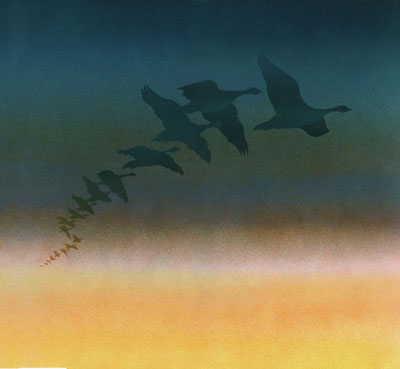
Meanwhile the wild geese, high in the clean blue air,
are heading home again.
Whoever you are, no matter how lonely,
the world offers itself to your imagination,
calls to you like the wild geese, harsh and exciting -
over and over announcing your place
in the family of things.

Sunday, 2 September 2007

The Nature of Mind


Bo and I have been talking a lot recently about how, as 'post pagans', ritual fits into our lives. I love ritual; sadly it's often the only chance I get to spend any real time out in nature. Feeding the ducks or walking in the woods with my 5 year old son is sacred in its own way, but, not surprisingly, there isn't any time for being able to sit silently and just let nature in. Ritual gives me a sense of connection and direction I just haven't found in any other spiritual practice. (I must put a note in here to say, at the risk of sounding like a terrible old snob, I am talking about good ritual, filled with poetry, music and silence - see Bo's other blog for examples of how this isn't done). Ritual is often connected with pagan practice, and we do still meet whenever possible at the natural turning points of the year (equinoxes, solstices, and the ones in between), and with other members of our little group we still mark the circle by calling quarters, though we no longer call specific deities. I have been questioning that now I no longer label myself as a druid and certainly my daily prayers and practice aren't recognisable as pagan, then where does ritual fit into my life?

Tibetan Buddhist teachings talk of the 'nature of mind'; this is our inner most essence that is not touched by change or death. It is immune to the thoughts, plots, desires and emotion that we experience in our daily lives - the part of the mind Buddists call sem. It is our true essence, what others might think of as our soul or God within us.

Buddhists believe that at our death when all our wordly illusions fall away this boundless, 'sky-like' nature of our mind is revealed. However they also believe that under some circumstances glimpses of our nature of mind may be seen. Sogyal Rinpoche describes it "just as clouds can be shifted by a strong gust of wind to reveal the shining sun and wide open sky so some inspiration may uncover for us glimpses of this nature of mind". This is the understanding found in the heart of all religions -that there is a fundamental truth and that this life is an opportunity to recognise it and evolve. What the sufis would describe in terms of the hidden essence, the process of becoming a Lover and allowing the rest of your life to be burnt away by Love.

The Direct Path by Andrew Harvey demonstrates exercises and meditations from many different paths and religions, showing the underlying truth that connects them all. He recomends before starting any meditation to read a poem or piece of text that inspires and awakens awareness of God. To me, this is 'blowing the clouds away' to reveal the true nature of mind. Some of the times I have felt this most strongly has been in ritual with Bo. We have learned over the many years that we have been writing and practising ritual what type of poetry, text and music works for us to assist opening to that hidden essence. We have a full-moon ritual once a year during the June/July moon. This year, despite having both learned reems, the ritual, as they are often wont to do, took its own form, and we perfomed the whole thing in silence, with just some beautiful inspirational music to meditate to. It was probably one of the most powerful moments of my life, and there felt absolute connection between me, the summer night sky, the meadow we sat in, and the rabbit that came to sit with us and Bo. To me, that was definitely a moment of experiencing the nature of mind. Obviously Bo will have his own view on this, but I think it is this connection with God, the nature of mind, the hidden essence, that keeps us continuing to have a deep need for (good) ritual, despite being post pagans.

Songyal Rinpoche: The Tibetan Book of Living and Dying
Andrew Harvey: The Direct Path