Sunday, 9 September 2007

Magic


It has gradually become a conviction of Justine and myself that casting spells cannot be considered the activity of a mature personality. A big part of our problem with Paganism derived from the importance placed on magic, or even, God help us, 'magick'. It's the element of Paganism that leaves us most mystifed, I think, though Justine may disagree.

But, as always, this bald statement of mine requires qualification, and the ways in which magic(k) is conceptualised within Paganism differ considerably. At worst, it is a manipulative, self-aggradising spiritual technology, based very largely on chronic self-delusion, and those who practise it often tend to have some very nasty power issues. In this form, it's a bit like spiritual hacking: a way for geeks to go behind the scenes, round the back, under the radar, in order to achieve some selfish end.

But at best, as the work of luminous writers like Rae Beth makes clear, magic is a kind of embodied prayer, entirely compatible with the concept of petitionary prayer within other religions. It's something done in humility, on behalf of others, in openess to the divine generosity, which grants the request or not. It's not something that the practitioner does by themselves. I don't mean to be doctrinaire here, but it's clear, at least to me, that Pagan thinking about magic and prayer is all over the place.

* * *

There are various schools of thought about how magic works (putting aside, for the moment, the brisk objection that it doesn't.) The least sophisticated view is that represented by, say, Janet and Stuart Farrar in Ye Olde Wiccan mode.* According to this view, magic is an inherent force within human beings, which can 'raised', by chanting, dancing, sex, visualisation, etc., and 'channelled' by will-power towards particular desired goals, through the use of ritual objects such as charms, coloured candles, and the like.

If this was true, if it was really true, that with simple household objects and a few herbs wonderful results could be achieved, because a mysterious power unknown to science resides in the human body (easily activiated by reading a £6.49 book) no one would be fat, and no one would be lonely. We would simply all be calling ourselves SylverFaerieDancer, shutting the curtains, and sticking a needle through a coloured candle, in the full expectation that we'd then be more able to hold off the Chelsea buns or could expect Mr or Ms Right to troll round the corner in the imminent future.

Freud, despite many peculiar ideas, had the useful concept of the 'Reality Principle'. It needs rigorous application here.

A more sophisticated view might be that of Starhawk, a highly intelligent woman who is true to her Jewish roots in her mixture of practicality and prophetic witness. Aleister Crowley coined the axiom of ritual magic, that "Magic is the Science and Art of causing change to occur in accordance with the Will"; this alerts the reader at once that Crowley was a sub-Neitzschean third-rate nerd, addled on smack and deluding himself that his Dungeons & Dragons hallucinations represented some daemonic psychic reality. Dion Fortune adapted Crowley's dictum to read: 'Magic is the art of changing consciousness at will', which Starhawk has retained and built on. The difference is vital: instead of the quasi-scientific assertion of a hidden, manipulable system behind the manifest universe, Fortune recognised that it is only ourselves which we can change. In books such as Dreaming the Dark, Starhawk fused this (ancient) insight with political and environmental activism, daring people to change their consciousness to envision radically more just ways of being-in-the-world. If this is magic, it's a long way from the Farrars' concept thereof.

The English Hedgewitch Rae Beth, who is in my opinion one of the only genuine and profound mystics among Wiccan writers, goes further. She recognises that ultimately magic must collapse into prayer, because human beings, and all creation, are radically dependent on the immanent and transcendent divine, in whom we live and move and have our being. She refers to the divine as 'Goddess and God', in classic Wiccan fashion, but in terms with which the 13th century Hindu saint Jnaneshwar would have been quite familiar.

Though she preserves the usual impedimenta of magic - candles, cords, herbs, and so on - she is quite conscious that all power for transformation ultimately comes from the divine, and that the only magic worth doing is that which aligns us with the divine will for healing, peace, and justice. Otherwise, we would be like fish in an aquarium on the back of a lorry headed north: no matter how hard the fish were to try to swim south, they would never get anywhere. For Rae Beth, magic is ultimately both a discipline of meditation, and a method of deepening mystical communion. Her writings glow with a sense of the divine's unimaginable wisdom. In its inerradicable sense of awe and gratitude, her magic is not self-aggrandisement, but self-abandonment. Thus, ultimately, it is prayer.

* * *

I quote now from Donald Spoto's beautiful In Silence: Why We Pray, on this subject.


Without doubt, petition at prayer is a topic often poorly understood - not only because of magical tendencies, and our attempts to manipulate or bribe God, but also because of a false opposition we tend to presume exists between human and divine intent. That divergence is due to the subtle, unspoken notion that submission to God's will means disaster for us, or at least some unpleasantness...At the root of this misperception is a lack of trust - of faith itself - in God's unimaginable and infinite mercy, and the lingering anxiety that He may not, after all, be Love straight through.

This sort of thinking...leads by a direct route to a wholly false idea of prayer. The practical result of such spiritual malfunction is 'prayers' that are not really prayers at all. - not expressions of longing for God and what harmonizes our existence with His, but rather examples of unattractive designs on destiny. Hence we pray to win a lottery, or to be rid of a meddlesome person in our life, or to control someone (by brute power or romantic ardor, for example) or to be spared the ordinary lot of the human condition.

...

But prayer is not a means of escape from the ordinary lot of physical and emotional life, which necessarily inolves experiences of dimishment, darkness and dying. In fact prayer is rarely the solution to any problem at all. We do not pray for utilitarian or functional or financial reasons, nor because prayer can produce beneficial results. We pray to know more deeply
Whose we are; from that awareness derives everything we genuinely neeed in this life.

Donald Spoto, In Silence: Why We Pray, pp. 75-6.


*Note the Amazon review by 'OakRaven', referring approvingly to the Farrar's 'Spells and How They Work' as a useful guide to 'SpellCraeft' [sic]. Blergh.

Monday, 3 September 2007

Wild Geese

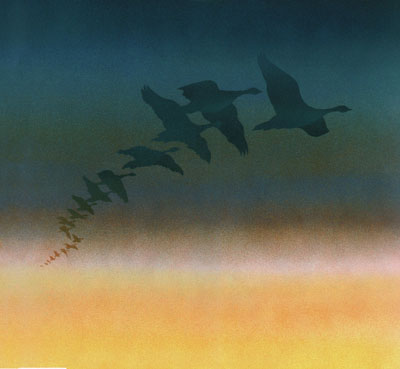
Still on the 'nature of mind', this beautiful poem by Mary Oliver never fails to blow me away. I first discovered it not long after my (now) ex-husband and I separated, and it pulled me through some very dark times. Not overtly 'spiritual' but stunning all the same.


You do not have to be good.
You do not have to walk on your knees
for a hundred miles through the desert repenting.
You only have to let the soft animal of your body
love what it loves.
Tell me about despair, yours, and I will tell you mine.
Meanwhile the world goes on.
Meanwhile the sun and the clear pebbles of the rain
are moving across the landscapes,
over the prairies and the deep trees,
the mountains and the rivers.
Meanwhile the wild geese, high in the clean blue air,
are heading home again.
Whoever you are, no matter how lonely,
the world offers itself to your imagination,
calls to you like the wild geese, harsh and exciting -
over and over announcing your place
in the family of things.

Sunday, 2 September 2007

The Nature of Mind


Bo and I have been talking a lot recently about how, as 'post pagans', ritual fits into our lives. I love ritual; sadly it's often the only chance I get to spend any real time out in nature. Feeding the ducks or walking in the woods with my 5 year old son is sacred in its own way, but, not surprisingly, there isn't any time for being able to sit silently and just let nature in. Ritual gives me a sense of connection and direction I just haven't found in any other spiritual practice. (I must put a note in here to say, at the risk of sounding like a terrible old snob, I am talking about good ritual, filled with poetry, music and silence - see Bo's other blog for examples of how this isn't done). Ritual is often connected with pagan practice, and we do still meet whenever possible at the natural turning points of the year (equinoxes, solstices, and the ones in between), and with other members of our little group we still mark the circle by calling quarters, though we no longer call specific deities. I have been questioning that now I no longer label myself as a druid and certainly my daily prayers and practice aren't recognisable as pagan, then where does ritual fit into my life?

Tibetan Buddhist teachings talk of the 'nature of mind'; this is our inner most essence that is not touched by change or death. It is immune to the thoughts, plots, desires and emotion that we experience in our daily lives - the part of the mind Buddists call sem. It is our true essence, what others might think of as our soul or God within us.

Buddhists believe that at our death when all our wordly illusions fall away this boundless, 'sky-like' nature of our mind is revealed. However they also believe that under some circumstances glimpses of our nature of mind may be seen. Sogyal Rinpoche describes it "just as clouds can be shifted by a strong gust of wind to reveal the shining sun and wide open sky so some inspiration may uncover for us glimpses of this nature of mind". This is the understanding found in the heart of all religions -that there is a fundamental truth and that this life is an opportunity to recognise it and evolve. What the sufis would describe in terms of the hidden essence, the process of becoming a Lover and allowing the rest of your life to be burnt away by Love.

The Direct Path by Andrew Harvey demonstrates exercises and meditations from many different paths and religions, showing the underlying truth that connects them all. He recomends before starting any meditation to read a poem or piece of text that inspires and awakens awareness of God. To me, this is 'blowing the clouds away' to reveal the true nature of mind. Some of the times I have felt this most strongly has been in ritual with Bo. We have learned over the many years that we have been writing and practising ritual what type of poetry, text and music works for us to assist opening to that hidden essence. We have a full-moon ritual once a year during the June/July moon. This year, despite having both learned reems, the ritual, as they are often wont to do, took its own form, and we perfomed the whole thing in silence, with just some beautiful inspirational music to meditate to. It was probably one of the most powerful moments of my life, and there felt absolute connection between me, the summer night sky, the meadow we sat in, and the rabbit that came to sit with us and Bo. To me, that was definitely a moment of experiencing the nature of mind. Obviously Bo will have his own view on this, but I think it is this connection with God, the nature of mind, the hidden essence, that keeps us continuing to have a deep need for (good) ritual, despite being post pagans.

Songyal Rinpoche: The Tibetan Book of Living and Dying
Andrew Harvey: The Direct Path

Friday, 24 August 2007

Azam Ali


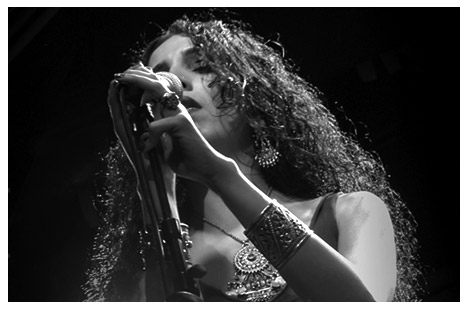
Here is Azam Ali of Vas, looking very Mirabai-esque, in a decent updating of traditional Persian music (which is absolutely amazing). She often sings Sufi poetry, in both Urdu and Farsi.


Two songs in one video - an Orthodox hymn from the Levant and another, medieval, song which appears on Ali's Portals of Grace, but the name of which I cannot recall.

Thursday, 23 August 2007

Rublev


Having quoted Rowan Williams earlier, I reproduce this poem, which means a great deal to me. Its simplicity, as always with Williams' poetry, hides great learning and tremendous psychological and spiritual subtlety. I hope to write something more about it soon.

Rublev is, of course, the famous Andrei Rublev, the greatest master of Russian icon-painting, who was born in the late 14th century. The poem is deeply bound to Rublev's miraculous icon of the Trinity, which shows the persons of the Trinity as angels seated at a table. It is in the Tretyakov gallery in Moscow.

* * *

Rublev, Rowan Williams, from The Poems of Rowan Williams

One day, God walked in, pale from the grey steppe,
slit-eyed against the wind, and stopped,
said, Colour me, breathe your blood into my mouth.

I said Here is the blood of all our people,
these are their bruises, blue and purple,
gold, brown, and pale green wash of death.

These (god) are chromatic pains of flesh.
I said, I trust I make you blush,
O I shall stain you with the scars of birth

For ever. I shall root you in the wood,
under the sun shall bake you bread
of beechmast, never let you forth

to the white desert, to the starving sand.
But we shall sit and speak around
one table, share one food, one earth.

Dhrupad


One of my own particular loves is sacred music, and the absence of any such tradition in Paganism was a constant disappointment. Accordingly, I'm going to try to post links to various traditions of sacred music that I particularly love on this blog.

The example gven above is of Hindu dhrupad chant, with demonstations of particular ornamental techniques. At first listening, it may sound like a collection of twangs and blips, but in fact it is an immensely subtle - and ancient - form of sacred music, with its origin in samavedic chant. Sir John Tavener has written that he listens to dhrupad more than any other form of sacred music, and the influence of dhrupad's microtones, sober ecstasy, and immensely long melodic lines is obvious in his own compositions. It's best listened to by candlelight, but be warned that at points the performer, a descendant of the famous Dagar brothers, interrupts himself. First he demonstrates a technique in which the voice is used to imitate the sound of a stringed instrument with uncanny accuracy, and later performs an ecstatic riff which sounds like a kettle boiling over.

I suspect the chant given here may be in honour of Krishna (if I am right in picking up the word Nand, a tender name used of Krishna) but wiser readers must enlighten me.

Mirabai ( c.1498-1573)


Mirabai is the most reknowned poet/saint of India. She was reluctantly married at eighteen to the Prince of Mewar. Her husband died soon into their marriage leaving her free to dedicate herself to Krishna; this for Mira was her life purpose. She spent time in public temples (usually only visted by those from lower castes) and sang, danced and embraced with untouchables. In order to escape from her murderous in-laws, Mira, now in her early thirties, renounced her title and fled. She spent the rest of her life living in places sacred to Krishna, dedicating her poetry to him. She spoke out on the injustices of religion, politics and the caste system and was clearly a formidable intellect. Her poetry is often humourous, erotic and ecstatic, reflecting the estatic union she achieved with her God. Mira would often dance with and for Krishna, like many transcendant mystics. She spent the last few years of her life attending the destitute near the Ranchorji temple.

The way Mira addresses Krishna is reminiscent of how many Sufi poets address Allah, with the tenderness and intimacy used to speak to a lover:

I Get Dizzy

I can't forget about love
for more than two seconds
I get dizzy if I think about anything
but the way you pant
in my ear.


I Want You To Have This

I want you to have this,
all the beauty in my eyes,
and the grace of my mouth
all the splendour of my strength,
all the wonder of the musk parts of my body,
for are we not talking about real love,
real love?